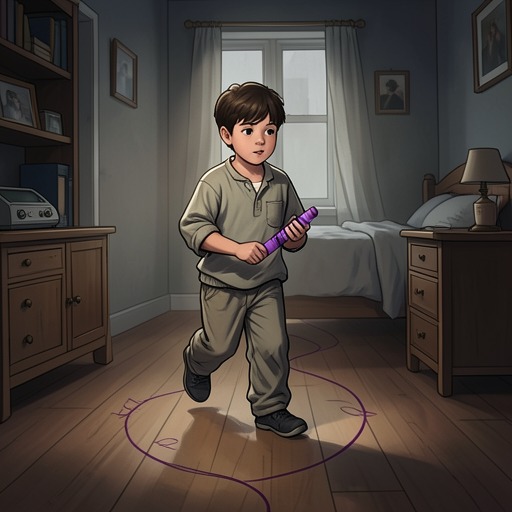
Harold remembers his window and goes to bed
Harold and the Purple CrayonHarold remembers his window and goes to bed is the resolving action of Harold’s night walk: after attempts to orient himself by paths, height, and a multitude of windows fail, he recalls a lasting relation between his bedroom window and the Moon. The recognition gives his search a destination at last, and the movement that began with drawing a way out ends with the familiar acts of making his bed and falling asleep.
From a drawn path to disorientation
At the beginning of the larger journey, there is no Moon, though Harold wants to walk in its light. He makes a long, straight path so he will not get lost, then sets out with The purple crayon. The plan seems to promise a simple connection between route and destination: draw a path, follow it, remain oriented. But Harold does not seem to be getting anywhere on the path. His eventual return therefore answers a problem established from the outset. A line can guide him in one sense without telling him where he is in relation to home.
The journey repeatedly tests his attempts to make surroundings legible. Harold leaves the straight route for a shortcut; later, seeking a place from which he can see where he is, he reasons that greater height will bring a wider view and turns a hill into a mountain. When danger intervenes, he keeps his wits and The purple crayon, makes a balloon, and grabs on. These episodes show the changing means by which he tries to gain control: first a path underfoot, then height and a view, then a way to travel above the ground. Yet the final obstacle is not simply distance or danger. Even a broad view and a means of escape do not tell him which window belongs to his bedroom.
The search for the right window
Harold’s difficulty becomes especially clear when he makes many buildings full of windows, then a whole city full of them. The abundance of possible windows does not help him identify his own: none is his, and he cannot think where it might be. The scene reverses the apparent usefulness of making more. Harold can create an expansive built landscape, but quantity supplies no personal landmark. A city full of openings makes the missing one harder to distinguish rather than revealing it.
This failure gives the remembered window its importance. Harold has been trying to recover a particular place by producing or surveying outward signs, but the city offers only undifferentiated alternatives. The way home depends instead on remembering a relation that connects his bedroom to something he can locate. The search changes when he ceases to look for the window as an isolated object and recalls where it is in relation to the Moon.
Recognition under the Moon
As Harold walks along with the Moon, he wishes he were in his room and in bed. Then, suddenly, he remembers where his bedroom window was when there was a Moon: it was always right around the Moon. The recollection supplies the missing orientation. Earlier, the absence of the Moon had been the reason he needed to make one for his moonlight walk; now the Moon is present in his movement and becomes a directional marker for finding home. Its role shifts from a condition of the imagined walk to a point of reference that makes the bedroom locatable.
The recognition is concise, but it resolves the distinction between making a route and knowing where the route leads. Harold’s straight path could be drawn to prevent him from getting lost, yet it did not seem to carry him anywhere. The many windows likewise offered no way to single out his own. Remembering that the window is always around the Moon gives him a usable connection between the night landscape and the private room he wants to reach. The solution is not another constructed road or another collection of landmarks; it is the recovery of a spatial relation he already knows.
Return and closure
After remembering, Harold makes his bed. He gets into it and draws up the covers; The purple crayon drops to the floor, and Harold falls asleep. The ending returns the story from its immense, changeable outdoor settings to the intimate scale of the bedroom. The bed is no longer merely the place he wishes to be: it becomes the place he reaches and settles into. The sequence gives the recognition a concrete consequence, moving from memory to arrival and from arrival to sleep.
The crayon’s fall marks a quiet stopping point for the instrument that has accompanied Harold’s acts of making. During the walk, he used it to create routes and surroundings, including responses to frightening or uncertain situations; at the end, it lies on the floor while he sleeps. The ending does not describe another drawing or a further search. Instead, the tool is set aside as the night’s activity gives way to rest.
Narrative significance
This action completes a progression from deliberate orientation, through failed searching, to remembered orientation. Harold begins by drawing a straight path because he does not want to get lost, but the path alone cannot ensure that he is making progress. Later, greater height, a balloon, and a city of windows each offer a different kind of practical possibility without identifying his home. His memory of the bedroom window around the Moon succeeds because it links a familiar private place to a visible point of reference.
The ending also brings the story’s imaginative activity back to an ordinary routine. Drawing has enabled Harold to shape what he encounters, but the resolution is not another invention: it is the recollection of where his own window belongs. Making the bed, pulling up the covers, and falling asleep complete the return in plain, physical actions. The final contrast between the many windows he could make and the one window he remembers gives the journey its shape: home is found not by multiplying possibilities, but by recognizing the particular relation that leads back to it.